

Travel Manager's Guide to Corporate Travel RFPs
Selecting the right TMC can have a lasting impact on your travel program.
A corporate travel RFP is one of the most important procurement exercises a travel manager will run. Get it right, and you’ll have a travel management partner that actually fits your organization. Get it wrong, and you’ll be back in this process in two years.
This guide covers everything: when to run an RFP, how to structure it, what to ask, and how to evaluate proposals beyond price. It also includes simplified steps to guide you through the RFP process, with a free downloadable package of templates, scorecards, and checklists built specifically for travel managers.
No fluff. No filler.
Just a practical guide from people who’ve been on both sides of the table.
Get the Free RFP Toolkit
What's Included in the Fox World Travel RFP Toolkit
The toolkit is a free download that gives travel managers everything they need to align your key stakholders with a structured corporate travel RFP. Here’s what’s inside:
TMC RFP Template
A complete, structured RFP template covering all the categories a corporate travel RFP should address: service model, technology, implementation, reporting, pricing, and references.
Pre-written sections you can customize for your organization — not a blank document.
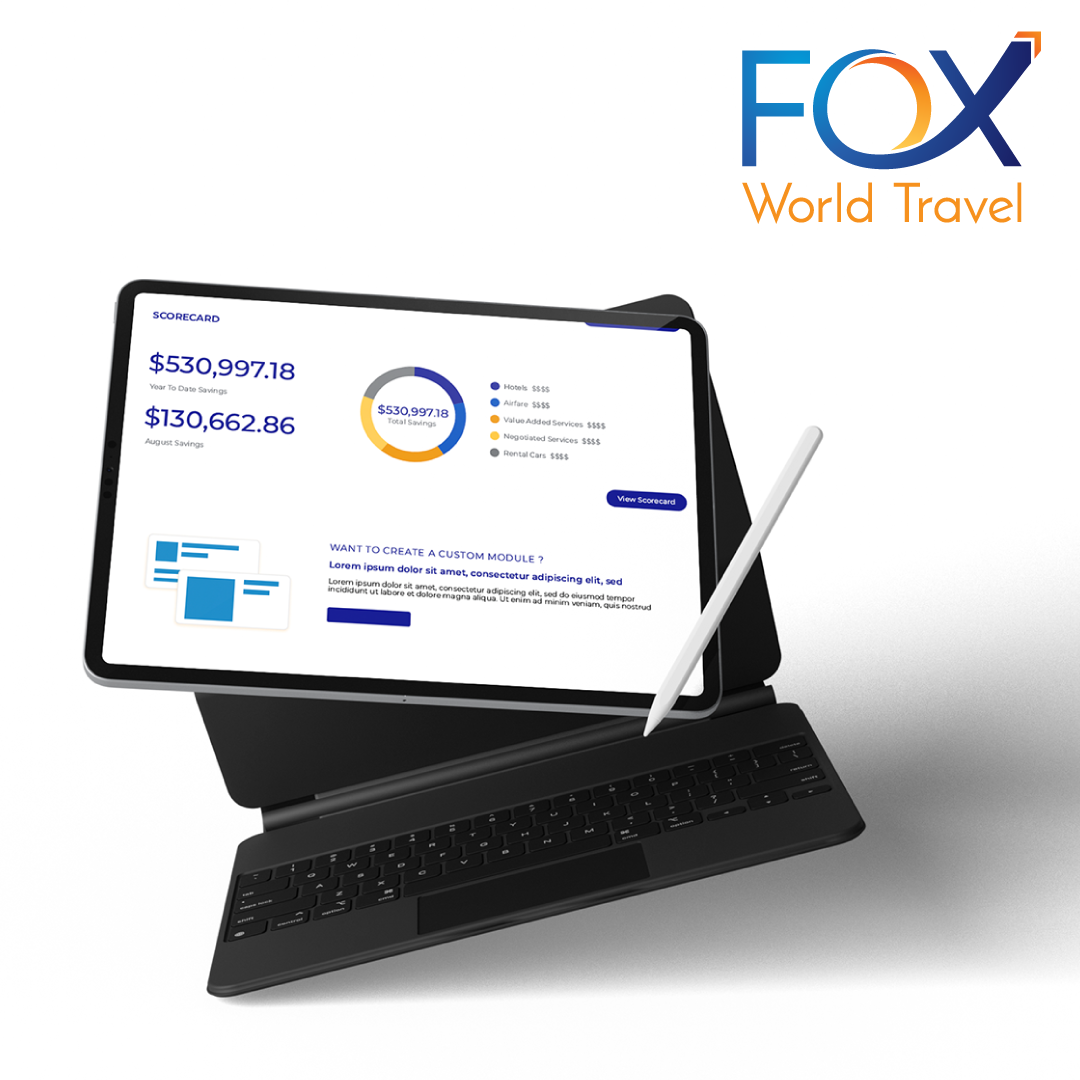
TMC Evaluation Scorecard
Compare travel management companies using a structured scoring framework that helps you evaluate service, traveler support, implementation, technology, reporting and overall program fit, not just pricing.

Question Bank
50+ RFP questions organized by category, designed to help travel managers evaluate how well a prospective TMC will support their travelers, goals and program requirements.
Covers the questions most travel managers forget to ask — until it's too late.

Program Data Checklist
Providing accurate travel data enables TMCs to give more relevant and tailored solutions and pricing to meet your objectives. The worksheet helps you identify data needed to build your RFP evaluation categories. A reference call framework with the exact questions to ask a TMC's existing clients.
Because a reference call without a script is just a sales call by another name.

When Should You Run a Corporate Travel RFP?
Not every TMC evaluation requires a formal RFP. But in certain situations, running a structured RFP isn’t just recommended; it’s essential. Here are the most common triggers:
Your contract is up for renewal
Most TMC contracts run 2–3 years. An expiring contract is the natural moment to evaluate whether your current provider is still the right fit — or whether the market has better options.

Your TMC was acquired
TMC mergers and acquisitions happen regularly. If your provider was acquired recently, your account team, technology, and service model may change significantly. An RFP lets you reset on your own terms.

Your program has grown significantly
A TMC that was right for $1M in annual air spend may not be the right fit at $5M. Program complexity — international travel, multiple offices, compliance requirements — changes what you need from a partner.

Service has declined
Traveler complaints are increasing. Reports aren't telling you what you need. Your account manager changed for the third time. These aren't isolated issues — they're signals that the relationship isn't working.
How to Structure a Corporate Travel RFP
A well-structured TMC RFP covers eight core categories. Each category should have specific questions and clear evaluation criteria. Here’s the framework:
- Account Management — Who is your dedicated contact? What’s their experience level and tenure? How does escalation work? What does day-to-day account management look like?
- Duty of Care — How do you track traveler location in real time? What is your protocol during a disruption or emergency? What duty of care tools and reporting do you provide?
- Traveler Experience — How do you support travelers before, during, and after a trip? What does 24/7 support look like in practice? How do you handle after-hours disruptions?
- Cost Control & Data Visibility — What reporting and benchmarking do you provide? How do you identify and close spend leakage? What does your data dashboard look like?
- Operations & Services — What is your operational model? How are reservations handled? What are your SLAs for response times and issue resolution?
- Implementation & Onboarding — What does the transition process look like? What is the typical timeline? How do you manage traveler communication during the switch? What happens to unused tickets?
- Technology & Distribution — What booking platforms do you support? What proprietary tools do you offer? How do you handle online booking tool configuration and adoption?
- Additional Services Available — What ancillary services do you offer — meetings & incentives, group travel, visa and passport support, sustainability programs?
Questions to Ask Every TMC Reference
- What was the implementation process like? And what would you do differently?
- When something goes wrong, how does the team respond?
- Has your account team changed since you started? How many times?
- If you had to do the TMC selection over again, what would you ask that you didn’t?
Would you recommend this TMC to a peer at another company?
How to Evaluate TMC Proposals Beyond Price
Price is important. But the TMC that wins on price alone often ends up costing more in the long run. Through service failures, compliance gaps, and the hidden cost of switching again in two years. Here’s what to look for beyond the fee structure.
- Service model depth: Does the TMC assign a dedicated account manager, or are you getting a shared pool? Ask to meet the person who will actually run your account, not just the sales director.
- Technology fit: Does the platform work the way your travelers actually book? Ask for a live demo with your specific use case, not a generic product walkthrough.
- Implementation track record: Ask for 3 client references who switched from a previous TMC. Specifically ask references about the transition timeline, what went wrong, and how it was handled.
- Cultural fit: A travel management company should understand the realities of your organization, whether that means supporting global travel, balancing multiple stakeholder priorities or helping a lean travel team accomplish more with fewer resources.
- Financial stability: In a market with significant M&A activity, ask directly about ownership structure, acquisition plans, and financial backing. A TMC acquisition mid-contract can mean starting over.
- Exit terms: Before signing, understand exactly what leaving looks like, data portability, notice periods, unused ticket handling, and system access during transition.
Your Corporate Travel RFP Questions, Answered
A full corporate travel RFP process, from issuing the document to signing a contract, typically takes 8 to 16 weeks. This includes time for TMC responses (2–4 weeks), evaluation and shortlisting (2–3 weeks), finalist presentations (1–2 weeks), reference checks (1 week), and contract negotiation (2–4 weeks). Running a tighter process is possible, but it risks rushing decisions with 2–3-year consequences.
Most travel managers invite 3 to 5 TMCs to respond to an RFP. Fewer than 3 limits your ability to compare meaningfully; more than 5 creates evaluation burden without proportional benefit. Start with a longer list of candidates, narrow to 5 based on initial screening criteria, then issue the formal RFP to those 5.
An RFI (Request for Information) is a lightweight pre-qualification step, used to gather basic information about a TMC’s capabilities before deciding who to invite to a full RFP. An RFP (Request for Proposal) is a formal document that requests a complete service and pricing proposal. If you’re evaluating unfamiliar TMCs, an RFI is a useful first step. If you’re working with a known shortlist, go straight to the RFP.
A consultant can provide expertise, benchmarking and market insight, particularly for more complex travel programs. However, many organizations successfully manage the process internally when they have a structured framework, clear evaluation criteria and a strong understanding of program goals. The key is having a clear framework and the right questions, regardless of who’s running the process.
Organizations moving from unmanaged to managed travel for the first time face a slightly different evaluation. You’re not comparing a new TMC to an existing one; you’re evaluating what managed travel will look like from scratch. Focus your RFP on implementation support, traveler adoption, technology ease of use, and the TMC’s track record with first-time managed programs. The Fox RFP Toolkit includes guidance specific to this scenario.
Ready to Evaluate Your TMC Options? run your TMC RFP?
Download the free Fox World Travel RFP Toolkit with the templates, evaluation tools, and practical guidance built specifically for travel managers by corporate travel professionals.